Article • Reading 7 mins
Article • Reading 10 mins
Discover Paweł’s story: after 19 years at an airport, he switched to IT and now works as a Drupal Developer at Speednet.
Author

Sandra Żbikowska
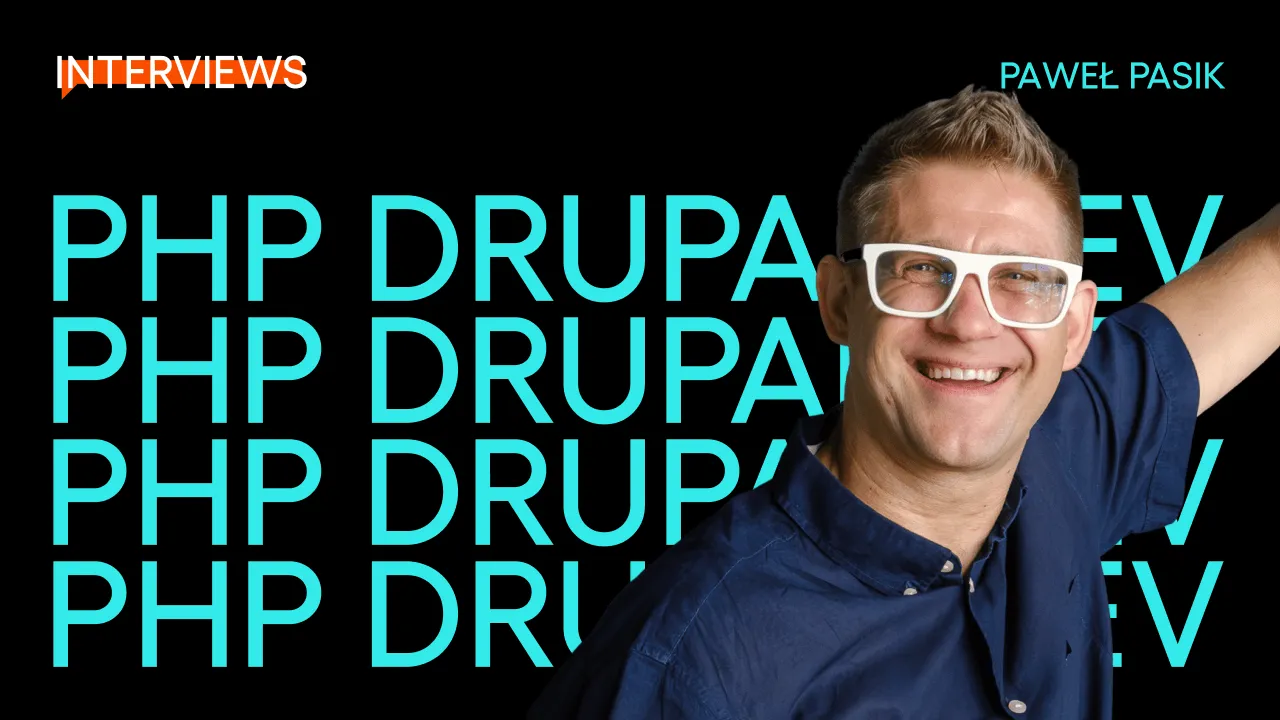
Meet Paweł, a Drupal Developer who tells us about the technology he works with and the challenges involved in changing careers.
Paweł: Good question! Drupal is a CMS written in PHP that is used to build and manage websites. It works well for both simple websites and complex portals or web applications. It is an interesting technology. On the one hand, it is user-friendly for content editors, while on the other, it gives developers extensive opportunities to expand and customise the system. Drupal is a bit like building with blocks. You can experiment with different elements and put them together in whatever way works best for you. It is an excellent and intuitive content management system that allows you to present content in many different ways. You can quickly change how the same content is displayed. I also really like Drupal’s architecture. Once you understand entities, fields, views, modules, hooks and services, everything begins to form a logical whole. Most importantly, Drupal is open source. The community can contribute to its development, it is free to use, and it is constantly being improved. That is what makes it so interesting, despite being a relatively niche technology.
Paweł: The biggest challenge is that there are virtually no limits. The only thing that limits us is our imagination. There is no single correct method, and you do not have to approach a problem in one specific way. Drupal gives you a huge range of possibilities, so you can solve the same problem using several different solutions. Some are more efficient than others, which means it is ultimately up to you how far you want to go with it. I think that is both the challenge and the source of satisfaction at the same time.
Paweł: It was definitely a rather unusual career path. I studied physics and mathematics, and I have always had an analytical mindset. A long time ago, while I was still at university, I met the manager of a Scandinavian airline. We had a good conversation, and at some point he invited me to an interview. Not long afterwards, I started working in ground handling. I lived close to the airport in Gdynia, and my father worked in aviation. He was a military mechanic who worked on aircraft. It had always interested me, so I thought, “Why not?” I worked there for 19 years, and it was genuinely a fantastic chapter of my life.
There is a funny story behind my decision to change careers. I had a friend who was always complaining about his job. Although he desperately wanted to find a new job, he was extremely shy. He would often say, “You’re so happy, while I don’t even want to go to work…” When I asked why he did not change jobs and what he would actually like to do, he explained that he was currently working as a tester but wanted to become a developer and write code in Python.I said to him, “Listen, I can make it easier for you. I’ll change jobs too. We’ll join a company together, learn new things and have a good time.”
In the meantime, another friend told me that his company would soon be looking for interns to train as part of a new learning programme. I wanted to apply, so I decided that learning how to build websites would be a good place to start. That was how it began. After work, I completed every free YouTube course I could find. I worked at the airport from 4:00 a.m. until 8:00 or 10:00 a.m. By the time other people were having their first coffee of the day, I had already finished work. I had plenty of time, so I chose to dedicate it to learning. I was 40 at the time and resolved that I was going to change my life completely.
As soon as the company my friend had mentioned started recruiting, I applied. I passed the initial interview and then joined them as an intern. That was where I was first introduced to Drupal. I completed the training after two months. I enjoyed it and wanted to continue developing my skills. Then, purely by chance, I came across an online job advertisement posted by Daniel. Speednet was looking for a Senior Drupal Developer. A senior developer… I replied to the advertisement and wrote: “Hi, I’ve completed a short internship, I like Drupal, and I already know a little about it. I know there is a company that hires almost every Drupal developer it can find, so there is a chance you won’t find anyone, especially not a senior. Perhaps you would like me to join instead? Maybe I’ll be a good fit, maybe I won’t.” Two weeks later, they contacted me. I had my first recruitment interview, followed by a technical assessment, and I received a positive response the very next day.
That was how my journey at Speednet began. At the same time, I continued working at the airport because I felt that I was still in the process of learning the language of programming. Sometimes, I would read the same piece of code four or five times and think, “What am I actually looking at?” It was a bit like opening a Chinese language textbook, staring at characters that all seemed to blend together and trying to understand what they meant. At the same time, there was something incredible about it. Suddenly, I was writing code – almost like lines of poetry – in a complex programming language that a computer could read, understand and execute exactly as I intended. It was a huge challenge for me, but I decided that I was not afraid of anything.
Paweł: Learning a programming language from scratch. I felt like a preschooler surrounded by adults. Sometimes I reinvented the wheel because I did not know the wheel already existed. At first, I would feel proud of finding a solution, only to discover that there was already a method for doing exactly the same thing. Many of the problems I tackled had already been solved. Instead of using existing approaches, I would come up with overly complicated ways to achieve something, only to later realise that the solution had been there all along.. I often laughed at myself when I realised how far behind I was and how much time I would have to spend catching up. Despite that, my curiosity kept me motivated to continue learning. I wanted to prove to both myself and others that I could do it. The worst part of the whole story is that my friend only bought a few courses and still works at the same company. I have been at Speednet for almost four years now, and he is still frustrated with his job. [laughs]
Paweł: When it comes to the industry and the technology, it is exactly as I said earlier. Drupal is beautiful and modular. It is genuinely complex and simple at the same time. It offers fantastic development opportunities and makes me want to become an expert in it. I know that tt is a long journey, which is why I try to contribute to the Drupal community. I participate in forums, create patches for modules and actively work towards that goal. As for the company – come on! The working atmosphere and the people around me are everything anyone could dream of when thinking about a great place to work. My goal now is to make my career at Speednet longer than my time with the airport, which means staying here for more than 19 years! [laughs]
Paweł: The people! They are the ones who create the atmosphere. It is what makes you want to come here. You genuinely want to be here! Our company events are not the usual stiff integration meetings that you have to attend simply because they are on the calendar, as can sometimes happen at other companies. No – here, everyone is genuinely involved and full of energy, and that is beautiful.
When I worked at the airport, I was in constant contact with other people, and I enjoy being around them. I am a very sociable person, so I feel fulfilled when I can come in, talk to everyone and be somewhere where a lot is happening. That is why I try to attend all of our company events.
Paweł: Hahaha! That’s right. My friend Błażej introduced me to the world of board games. He also works at Speednet, and I have known him since kindergarten [laughs]. When we were at secondary school, he showed me my first game, Puerto Rico, followed by Agricola, and I really enjoyed them. Later, Łukasz – who is currently developing his own fantastic game, tried to get everyone involved in playing together. I attended every meeting he organised because I wanted to help maintain this wonderful community.
I love board games – explaining the rules, introducing games to other people and developing my own skills through them. – I can play chess, cards or almost anything else. The important thing is that we do it together. When Łukasz stepped away from organising the board game meetings and there was a gap to fill, I took over. I gave up computer games in favour of board games because I wanted to spend time with other people. In my opinion, it is a fantastic way to spend your free time.
Paweł: They help people build relationships, and in my opinion, that is the most important thing. I would still like the team I currently work with on my project to become more involved in our company’s social activities. Unfortunately, some of them live far away from the office, while others simply have very busy schedules. It is great that we have initiatives such as Piękne Piątki (“Beautiful Fridays”) and other activities organised by the company. They encourage people to come to the office and give us an opportunity to spend time together and strengthen our relationships.
Paweł: An opportunity like that has actually already come up. I am not sure how much I can say about the details, but we have an initiative involving taking over a portfolio of websites from a client and rebuilding them in Drupal. There is also an idea to use AI as part of the process, so that is currently the direction in which my professional development is heading. My role involves supporting a Senior PHP Developer as they get up to speed with the technology, as well as exploring how we can train models to recreate existing websites in Drupal. The point is to take a website that we can see, but whose source code we do not have, and reproduce it correctly in Drupal. It is an additional project that I work on outside my regular hours because I want to develop my skills in this area. I think that answers your question perfectly. As it happens, this initiative brings everything together: a different role, new opportunities and professional development in the field of AI.
You may also like
Article • Reading 7 mins
Article • Reading 9 mins
Article • Reading 7 mins
Article • Reading 7 mins